Buy now, pay later has become a default payment method for students in the US, UK and Australia — and international students are heavy users, because BNPL asks for a debit card rather than a credit file. That makes it genuinely useful for a laptop or a deposit on an apartment. It also makes it easy to misuse, especially since the category is surrounded by claims that do not survive contact with a checkout page.
This guide covers what BNPL actually does for international students in 2026: the real mechanics and fees, why it cannot pay your tuition, where it does help, how it interacts with credit building, and what the regulators in each market have actually done.
How Pay-in-4 Actually Works
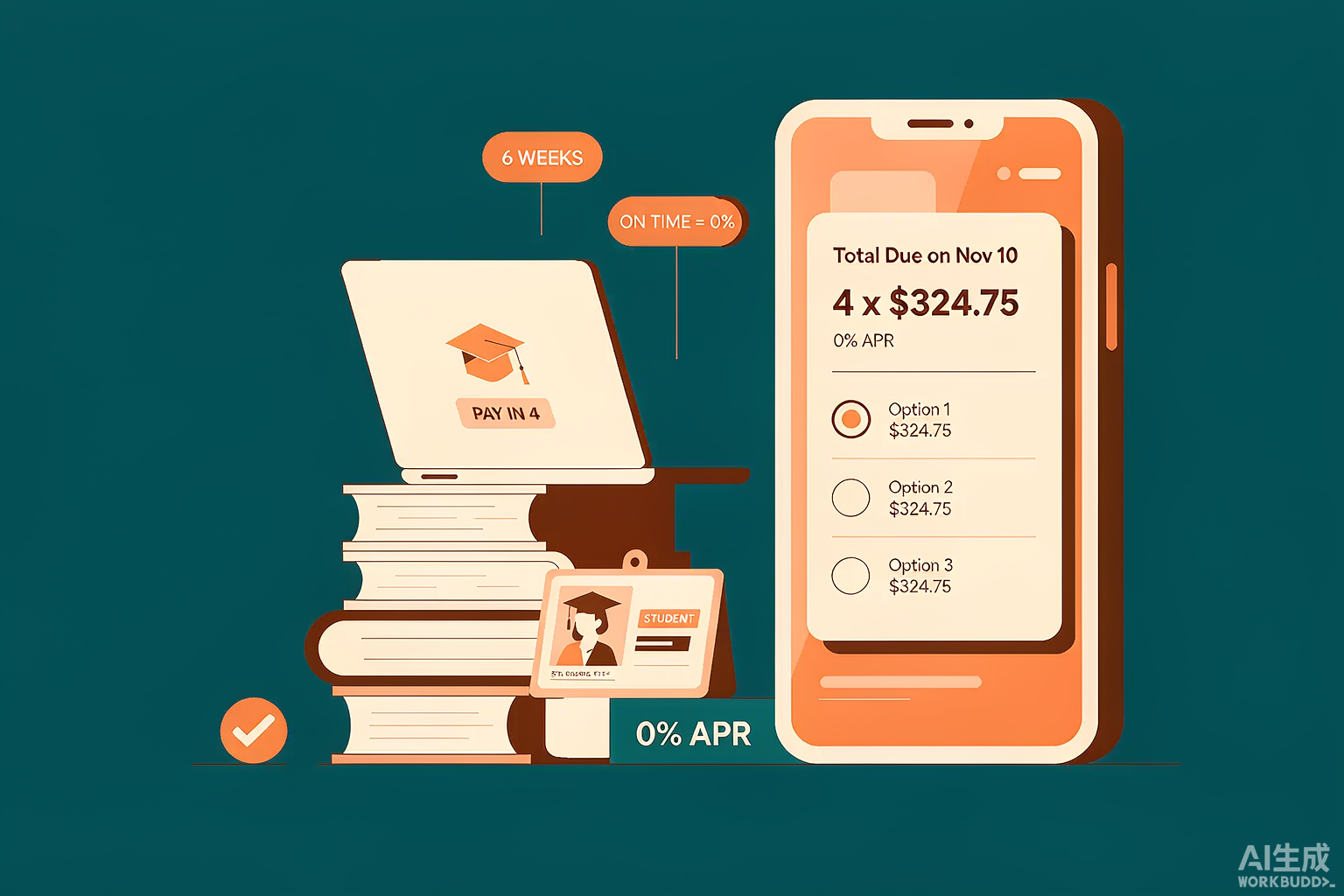
The dominant product splits a purchase into four equal payments over six weeks:
- 25% at checkout, then three more payments every two weeks
- 0% interest if every payment lands on time — the merchant pays the provider instead
- Late fees that vary by provider: Klarna charges roughly $7, Afterpay $8 per missed instalment capped at 25% of the order value, and Affirm charges no late fee at all (though it may suspend the account and report delinquencies)
- Credit checks that are usually soft, so shopping around does not damage your file — but some larger plans trigger a hard check
Longer plans — 6, 12 or 24 months — do charge interest, typically advertised as an APR range rather than a flat 0%. Those are the products where the cost comparison to a credit card actually matters, and where the “interest-free” marketing stops applying.
The Tuition Myth
You cannot pay tuition with Klarna, Afterpay, Affirm or Sezzle. This is not a limitation of your account — it is a structural mismatch. BNPL works only at merchants that have integrated the payment method, and university bursars have not. The platforms also exclude education and tuition payments in their terms, and their per-purchase limits (roughly $500 to $3,000 for most users) sit far below a semester bill.
What universities do offer is their own instalment plan, usually administered through servicers such as Nelnet or Heartland ECSI. These plans split the semester bill into monthly payments aligned to the academic calendar, are typically interest-free, and carry an enrolment fee of around $25 to $50. Crucially, the school recognises them as satisfying your obligation — which BNPL never does.
| Option | Pays tuition directly? | Typical cost | Credit impact |
|---|---|---|---|
| University instalment plan | Yes | Usually 0% interest; $25-$50 enrolment fee | None |
| BNPL (Klarna, Afterpay, Affirm) | No | 0% if on time; late fees if not | Mostly none; some report |
| Personal instalment loan | Yes, if paid to the school | Interest applies, priced on credit | Reported as a tradeline |
For the broader question of how to fund tuition as an international student, our guide to choosing a student instalment loan covers the options that actually reach the school.
Where BNPL Genuinely Helps
The useful use cases are the ones BNPL was designed for — retail purchases with a defined price and a short horizon:
- Technology: a $1,299 laptop at 4 × $324.75 spreads the hit across a semester’s cash flow, and Apple, Best Buy and Amazon all accept BNPL at checkout
- Moving and furnishing: mattresses, desks, kitchen kits — the arrival-month spike that catches new students out
- Flights home: seasonal fares that are cheaper booked early than saved for
- Textbooks and course kit, where the alternative is putting it on a credit card at 20%-plus
What BNPL is not good for: groceries, rent, or anything you would struggle to pay for in six weeks anyway. A four-payment plan on a recurring expense is not budgeting — it is a rolling overdraft with fees attached.
Market Size, Without the Hype
Industry tracking puts global BNPL transaction volume at roughly $560 billion in 2025, growing at about 10% a year and projected to reach $911.8 billion by 2030. In the US, Federal Reserve survey data shows about 16% of adults used BNPL in the past 12 months, with typical purchases between $600 and $1,000.
Note what that mix is made of: fashion, electronics, travel and home goods. Education is a rounding error, which is the quantitative version of the tuition point above. Any article claiming education is BNPL’s fastest-growing category is describing a market that does not exist.
Beyond BNPL: Instalment Credit
Credit cards
This is where international students hit a hard wall: most US card issuers require a Social Security Number. The Discover it Student card, often recommended online, requires an SSN — it is not available without one. Realistic paths are narrower:
- ITIN-accepting issuers: a limited number of banks and credit unions open cards for ITIN holders; you need the ITIN first, which requires a tax filing
- Secured cards: a cash deposit becomes your limit; most still require an SSN, but some credit unions accept ITIN holders
- Authorised user: being added to a family member’s US card builds a file without any application
- Campus credit unions: the most likely to underwrite students with thin or foreign files, often with proof of enrolment and a stipend letter
Personal instalment loans
For larger needs with a 12 to 36 month horizon, personal loans are the reporting workhorse: nearly all of them furnish payment history to the bureaus, which is why they build credit faster than BNPL. Be careful with the marketing — Upstart, for example, does use alternative data, but it still requires an SSN and a US credit file, so it is not a route for a student who arrived last month.
Co-signer loans
As with auto loans, a co-signer with established local credit unlocks larger amounts and better pricing. In the US the co-signer generally must be a citizen or permanent resident with an SSN, which rules out parents living in China. Our guide to co-signer strategies sets out what lenders actually require.
Regulation in 2026
The rules moved in opposite directions in different markets this year, which is worth knowing before you assume a protection applies to you:
| Market | Status of BNPL regulation |
|---|---|
| United States | The CFPB’s 2024 interpretive rule treating BNPL like credit cards was overturned by Congress in May 2025. There is no federal BNPL-specific disclosure regime; longer-term plans remain covered by Truth in Lending, and state rules vary. |
| United Kingdom | The FCA regime for BNPL took effect on 15 July 2026, bringing providers into scope with affordability checks, clear pre-contract information and access to the Financial Ombudsman. |
| Australia | The BNPL Act 2025 commenced on 10 June 2025, requiring providers to hold a credit licence and apply modified responsible lending obligations, with AFCA access for disputes. |
| Canada | No BNPL-specific federal regime; provincial consumer protection law and the industry’s voluntary code apply, with affordability checks left largely to providers. |
The practical difference: in the UK and Australia you now have a regulator to complain to and a documented affordability process. In the US and Canada, protection depends far more on the individual provider’s terms.
Does BNPL Build Credit?
Mostly no, and the exceptions matter:
- Sezzle Up (opt-in, free) reports eligible payments to Equifax, TransUnion and Experian as an instalment tradeline — the only mainstream BNPL that reaches a scoreable file. It requires SSN verification, so students without one cannot use it.
- Affirm reports to Experian and TransUnion, but the data sits in a BNPL section that scoring models do not yet read.
- Klarna reports only its longer monthly financing; Pay in 4 builds nothing.
- Afterpay, Zip and PayPal Pay in 4 report no on-time activity at all.
FICO introduced BNPL-specific scores (FICO Score 10 BNPL) in June 2025, so this picture is still moving. But the honest summary for a student is that BNPL is not a credit-building strategy — a secured card or a small instalment loan does that job far better. For a deeper comparison, see our guide on using BNPL to build credit.
The Debt Trap, in Numbers
The risks are documented rather than hypothetical. CFPB research found that 61% of BNPL users have subprime or deep subprime credit scores, 63% held multiple BNPL loans at once, and 4.1% of loans incurred a late fee in 2023 at an average of about $10. New York Fed analysis shows credit card delinquency among 18-29 year olds hovering near 10%, with BNPL use highest in exactly that age group.
The structural problem is what researchers call phantom debt: BNPL obligations do not appear on a traditional credit report, so neither you nor a future lender sees the full picture. A January 2025 CFPB study found frequent BNPL users carried $453 more in personal loans and $871 more in credit card debt than similar non-users.
Rules That Keep It Safe
- Cap yourself at two active plans — three is where the due dates start colliding
- Add every plan to your monthly budget as a fixed bill, not as a payment you will figure out later
- Never use BNPL for rent, groceries or tuition — those need a payment plan or income, not a six-week bridge
- Keep one month of BNPL obligations in cash, so a delayed stipend does not trigger a late fee
- Turn on autopay with a buffer in the account; most late fees come from timing, not intent
- Check the provider’s late-fee cap and whether it reports to bureaus before you enrol in anything
Country Notes
United States
The deepest provider market and the widest merchant coverage, but the weakest regulatory floor after the 2025 reversal. Assume no statutory protection and read the plan terms.
Canada
Fewer providers, more conservative approval, and BNPL is less embedded in retail. Canadian banks’ newcomer programmes are often a better first step than BNPL for building a file.
Australia
The most mature market, now with a licensing and responsible-lending regime since June 2025 — which means providers must assess affordability before approving, and disputes can go to AFCA.
The Bottom Line
BNPL is a cash-flow tool with a narrow, legitimate job: spreading a planned retail purchase across six weeks at zero interest while you keep your savings intact. It is not tuition financing, it is not a credit-building strategy, and in most markets it is not regulated like credit. Used within those limits it costs nothing and solves a real problem. Used as a substitute for income or a loan, it becomes the most expensive way to buy time. Our full BNPL guide for overseas Chinese and the practical playbook for young professionals go deeper on provider-by-provider terms.